The Man Rewiring AI’s Brain
Our Guest- Nigel Toon
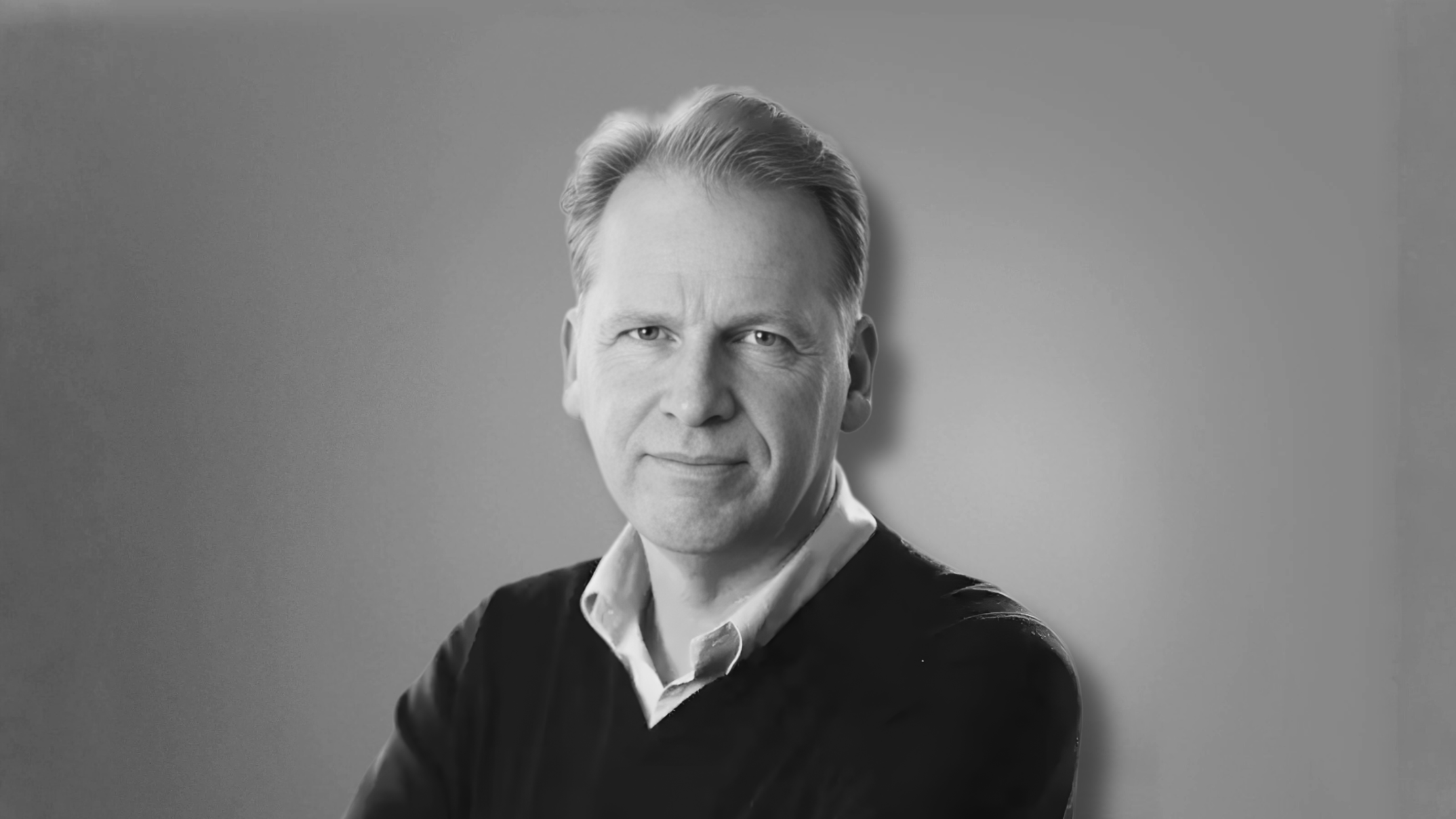
Nigel is CEO, Chairman and Co-Founder of Graphcore, a technology business leader, entrepreneur and engineer.
Prior to Graphcore, Nigel was CEO at two successful venture capital-backed processor companies and co-founder and board director at Icera, a 3G cellular modem chip company, which was sold to NVIDIA in 2011 for $435M.
He was previously a senior executive at a major Silicon Valley, publicly listed semiconductor company. He has served as a board member and chairman for several technology businesses and currently sits as the senior non-executive director on the board of UK Research and Innovation (UKRI), which is a non-departmental UK public body that directs over £8bn per year into research and innovation funding.
He has also been a member of the UK’s Prime Minister’s Business Council. Nigel is the author of 3 granted patents and has been awarded a Doctor of Science degree from the University of Bristol.
“Artificial intelligence isn’t about machines becoming smarter than humans, it’s about humans learning how to think more clearly in an intelligence revolution.”
-Nigel Toon
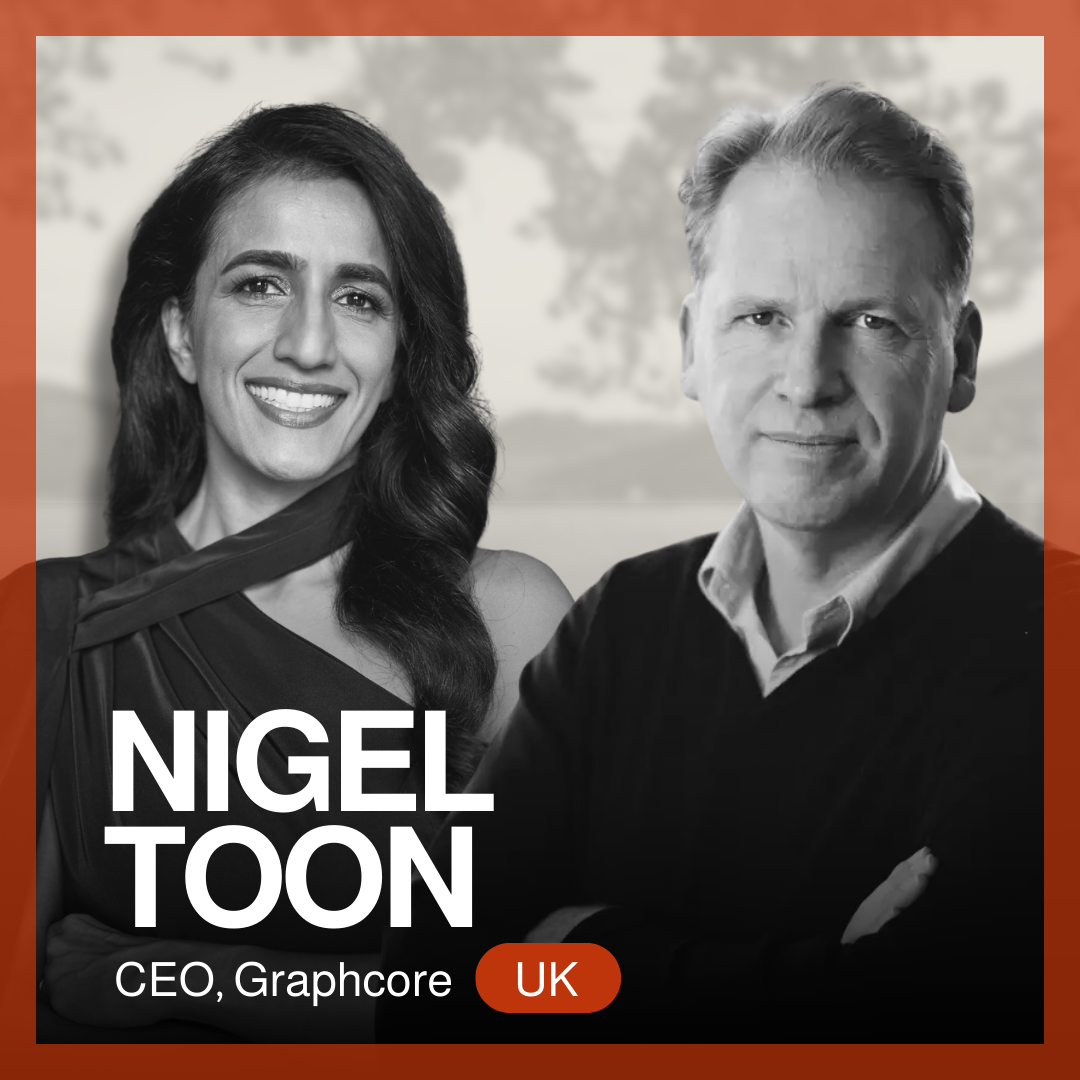
Most people think AI lives in the cloud.
Nigel Toon knows it lives in silicon.
When ChatGPT exploded into public consciousness, AI suddenly felt new, magical, almost spontaneous. But Nigel : co-founder and CEO of Graphcore: has been thinking about this moment for more than a decade.
Long before AI was fashionable, he was asking a quieter, more fundamental question: What kind of computer does intelligence actually need?
That question led to the creation of the Intelligence Processing Unit (IPU) : a new type of chip designed not for graphics or spreadsheets, but for how AI really works.
And like many big ideas, it didn’t start in a lab. It started in a pub.
From Pub Talk to Powerful Chips
In Silicon Valley, startups are born in garages. In the UK, Nigel jokes, they start over pints.
Graphcore began with two people sketching ideas, not knowing if AI would ever break out of the research world. At the time, the algorithms already existed. The internet already existed. What didn’t exist was enough computing power, in the right form, to make AI useful at scale.
Traditional computers work step by step. AI doesn’t. AI needs thousands of things happening at once, with data constantly moving, changing, and interacting. Nigel and his team believed that forcing AI to run on chips designed for yesterday’s problems was like trying to run a brain on a calculator.
So they built something new.
Why AI Isn’t Just “More Compute”
A lot of AI progress over the last decade has followed a simple rule: bigger models, more data, more compute. It worked : until it didn’t.
Nigel explains it simply: AI doesn’t learn from raw data. It learns from information, and information needs context. Language, images, and real-world signals all come with relationships and meaning. The challenge isn’t just processing more numbers : it’s getting the right data to the right place at the right time.
That’s where the IPU comes in. Unlike GPUs, which perform the same operation on lots of data, IPUs allow many different operations to happen at once. Nigel compares it to the human brain: billions of neurons, each doing something slightly different, all connected.
In other words, intelligence isn’t brute force. It’s coordination.
The End of One-Size-Fits-All AI
Nigel is famously skeptical about the idea of Artificial General Intelligence : the notion that one super-smart AI will know everything and replace us all. His argument is refreshingly human: people aren’t generally intelligent either.
We’re specialists.
Doctors, engineers, artists, managers : each trained deeply in context. Nigel believes AI will follow the same path. Instead of one giant brain, we’ll have many expert systems, each good at specific tasks, working together. Recent advances like “mixture of experts” models are already heading in that direction.
It’s less sci-fi apocalypse, more well-run team.
Building Companies Is a Roller Coaster
Graphcore raised nearly $700 million, grew to hundreds of employees, and was eventually acquired by SoftBank. But Nigel is quick to say that success doesn’t feel smooth while you’re inside it.
Running a company, he says, can feel like emotional whiplash. One day everything works. The next day everything breaks. The only way through is resilience : and a shared sense of purpose.
He likes the original meaning of the word company: people who come together to share bread. Investors, engineers, customers : all aligned around a common goal. That alignment, more than any single breakthrough, is what turns ideas into reality.
Why Education Matters More Than Ever
For all his work in hardware, Nigel keeps coming back to people.
AI, he argues, won’t make education less important. It will make it more important. Not memorization : but curiosity, creativity, and critical thinking. AI gives answers, but humans must decide whether those answers make sense.
In the near future, Nigel imagines each of us managing dozens of AI agents : booking travel, analyzing data, filtering information. We’ll be the managers. And like any good manager, we’ll need judgement.
A Quiet Optimist
Nigel isn’t worried about AI taking over humanity. He’s more concerned about whether humanity will step up.
Every technological revolution : agriculture, industry, now intelligence : demanded that people adapt. This one is no different. The tools are powerful, but they’re still tools.
And if there’s one thing Nigel Toon’s journey shows, it’s this: the future of AI won’t be shaped by hype or fear : but by thoughtful people, asking better questions, and building the right foundations.
Sometimes, that starts with a conversation. Sometimes, with a chip. And sometimes, in a pub.