Bringing AI to the Mongolian Steppe
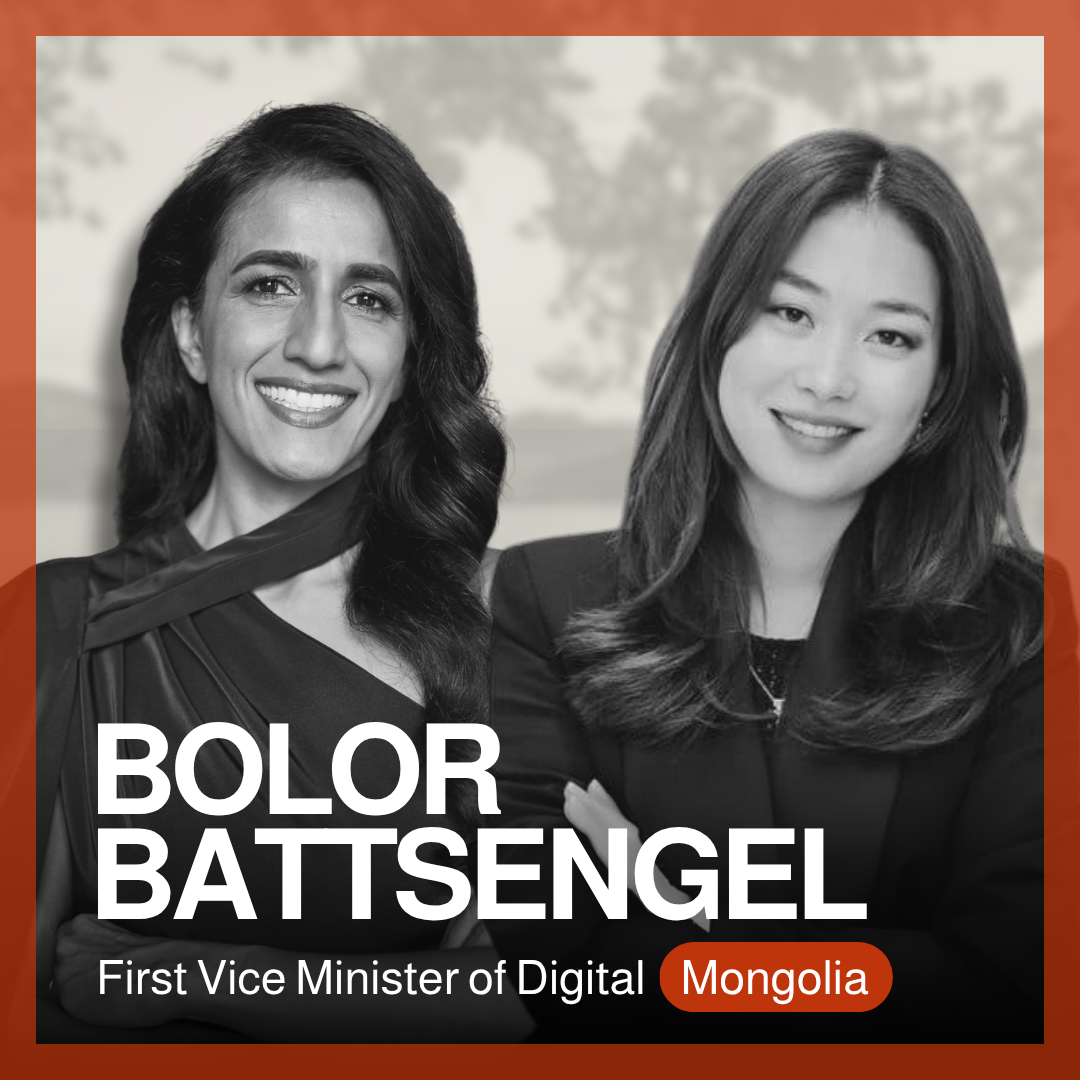
Our Guest-Bolor Battsengel

Bolor-Erdene Battsengel is a recognized global leader and Global Advocate for AI Inclusion, currently serving as CEO of AI Academy Asia. With extensive experience across technology policy, AI education, and strategic international collaboration, she is committed to bridging digital gaps and fostering innovation in emerging markets.
Her groundbreaking work as Mongolia’s first Vice Minister of Digital Development included launching the E-Mongolia platform, digitizing over 1,500 public services and significantly improving governmental transparency and efficiency. She also founded Girls Code, an NGO dedicated to empowering girls from rural and underserved communities through STEM and coding education.
Bolor-Erdene’s impact has attracted international recognition, with features in prominent global media outlets including TIME Magazine, CNN, and the Financial Times. Her continued leadership at AI Academy Asia emphasizes practical AI education, workforce readiness, and digital inclusion across Asia and beyond.
“If AI reaches the most remote areas, young people can use it to catch up with the world.”
— Bolor Battsengel
About the Episode
When Bolor-Erdene Battsengel was growing up in the Mongolian countryside, technology was a world away.
Her family lived a nomadic life, moving with the seasons, herding animals, and living close to nature. There were no computers, no phones, and no internet.
But even then, Bolor was curious about how the world worked. That curiosity would eventually take her from a small town eight hours from Ulaanbaatar to Oxford University, where she discovered how digital tools could change entire countries.
Today, she’s one of Mongolia’s leading voices in AI and digital transformation, proving that innovation doesn’t just come from big tech hubs, it can start anywhere.
Turning a Vision into Reality
At just 27, Bolor became Mongolia’s first Vice Minister of Digital Development. Her goal was simple but bold: make government services as easy to access as a mobile app.
She launched E-Mongolia, a national digital platform that turned 1,500 government services online from paying taxes to registering a business. What once took days now takes minutes. And in a country where many people live far from cities, that change meant real freedom.
Bolor also added a first-of-its-kind feature that lets citizens see when officials access their data, giving people real control and transparency.
Building AI for Everyone
After her time in government, Bolor turned her attention to AI inclusion, the idea that artificial intelligence should help everyone, not just those in wealthy countries.
She believes AI can be a great equalizer, especially for young people in developing regions. “If a student in a remote village can use AI to learn, she can catch up with the world,” Bolor explains.
To make that vision real, she founded AI Academy Asia, which trains teachers to teach AI across Mongolia. The program will reach 10,000 students by 2026, introducing children to everything from algorithms to ethics.
Empowering Girls Through Technology
Bolor also founded Girls Code Mongolia, a non-profit that helps girls from rural areas learn coding and STEM skills. Many of her students have already built their own apps and AI-powered projects - from safety tools for women to games inspired by Mongolian culture.
One graduate created an app that sends a signal to her parents when she feels unsafe on public transport. “That’s the power of tech,” Bolor says. “You learn a skill, and suddenly you can solve a problem that matters to you.”
AI With a Local Heart
Bolor’s vision for AI goes beyond efficiency and automation. She wants it to reflect different cultures and values, not just those of big Western tech companies.
“Most AI systems are trained on Western data,” she explains. “They don’t understand Mongolian traditions, languages, or ways of life. We need to design AI that includes us.”
For her, that means creating AI tools that respect local knowledge, from the herders who live off the land to the teachers guiding children through their first coding lessons.
From Mongolia to the World
Bolor now works with organizations like the UN, World Bank, and Starlink, advising on digital inclusion and connectivity projects across Asia. She’s also a regular speaker at events like AI for Good and the World Economic Forum, where she calls for more ethical, inclusive AI policies.
Her message is clear: AI shouldn’t widen inequality, it should close it.
A Future Without Borders
For Bolor, AI isn’t just about machines, it’s about people. She dreams of a world where technology helps children in remote areas learn faster, farmers manage their herds more efficiently, and small nations compete on equal footing with global powers.
“I want to see AI on horseback,” she laughs. “Technology that moves with people, not above them.”
From the grasslands of Mongolia to the global stage, Bolor Battsengel is showing that the future of AI can be as inclusive, diverse, and human as the world it serves.